
Yerba Mate is a holly species native to South America, particularly the region of Paraguay, Argentina, Uruguay, and southern Brazil. The leaves are used to prepare a traditional caffeinated beverage.
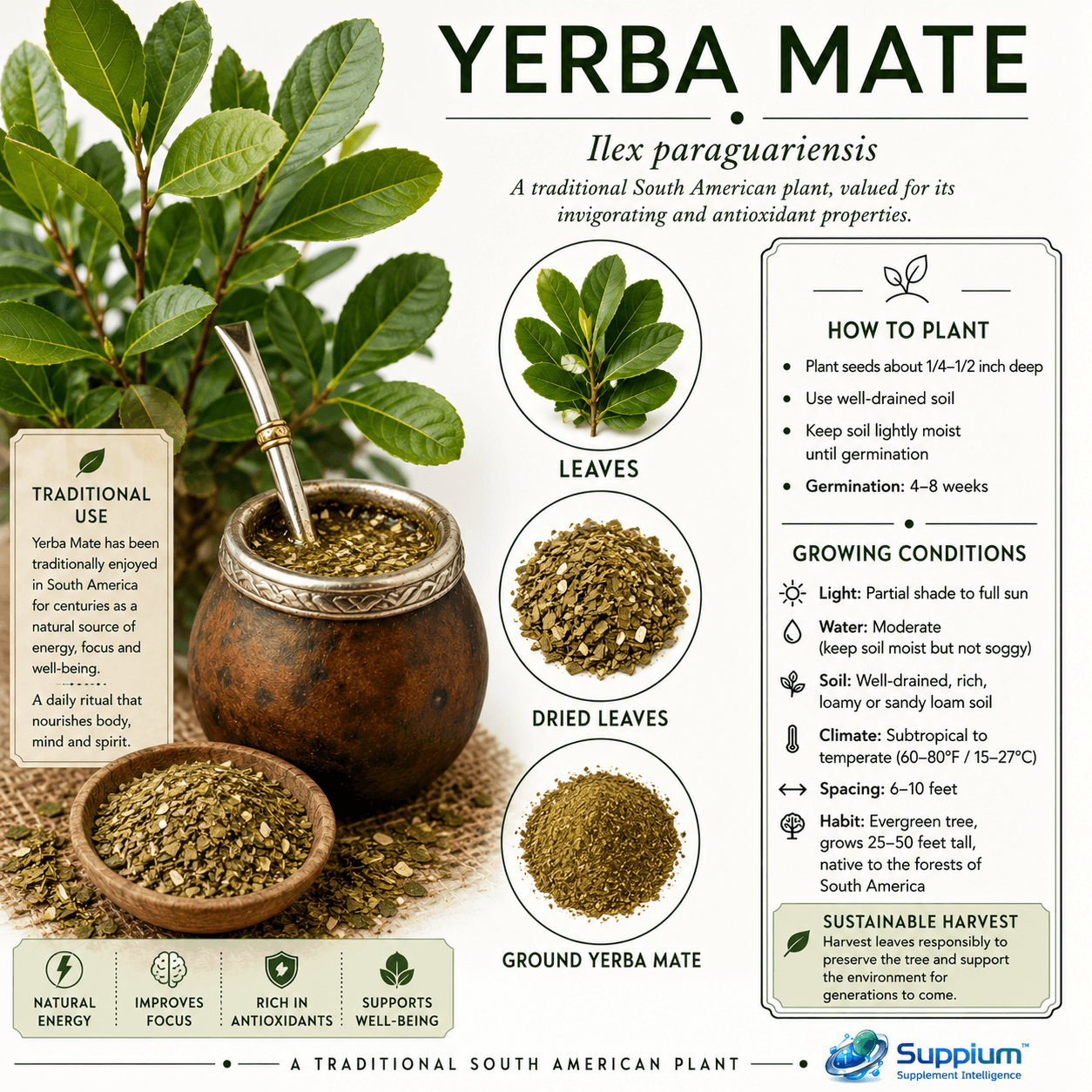
A. Identification
- Common Name (Localized by Country/Region)
- Yerba Mate
- Scientific (Latin) Name
- Ilex paraguariensis
- Regional Names, Multilingual Names, and Modisms
- ES: Yerba Mate PT: Erva-mate ES-AR: Mate Also known as: Mate, Erva-mate, Chimarrão
B. Origin and Cultural Context
- General Description
- Yerba Mate is a holly species native to South America, particularly the region of Paraguay, Argentina, Uruguay, and southern Brazil. The leaves are used to prepare a traditional caffeinated beverage.
- Origin and Cultural Context
- Geographic Origin: Argentina, Paraguay, Uruguay, Southern Brazil Tradition System: Latin American & Amazonian
C. Benefits
- Evidence-Based Benefits
- Contains caffeine, theobromine, and antioxidants. Human studies support cognitive and metabolic benefits. One of the most well-studied South American botanicals.
- Traditional / Historical Uses
- Traditional beverage consumed socially and for energy, mental clarity, and appetite control. Central to culture in Argentina, Paraguay, Uruguay, and Brazil.
D. Contraindications and Safety Warnings
- Contraindications
- Contains caffeine. May interact with stimulants and MAO inhibitors. Very hot consumption associated with esophageal concerns.
- Warnings
- Traditionally consumed hot through a bombilla. Temperature of consumption may be relevant to safety.
G. Formulations
- Preparation Methods
- dried leavestea bagsextractbeverage
Related Herb & Botanicals
caffeine
1,3,7-trimethylpurine-2,6-dione
1,3,7-Trimethylpurine-2,6-dione is caffeine, a purine alkaloid and methylxanthine compound rather than a true herb. It occurs naturally in several botanicals, including coffee beans, tea leaves, cacao, kola nut, guaraná, yerba mate, guayusa, and yaupon, and it can also be manufactured and added to foods, beverages, medicines, and dietary supplements. Because the administrator-supplied term maps in NIH DSLD to a non-nutrient/non-botanical ingredient group, the canonical category is compound even though many commercial and traditional sources are botanical. Caffeine is widely used for wakefulness, alertness, and performance contexts, and it is also present in some weight-loss and sports-performance supplements. Human evidence is strongest for short-term effects on alertness and for modest improvements in some endurance or intermittent sports tasks when appropriately timed. Evidence for meaningful stand-alone weight loss is weaker because trials often use multicomponent stimulant formulas and short durations. Safety depends heavily on total intake from all sources, individual sensitivity, pregnancy status, medicines, cardiovascular or anxiety conditions, and product concentration. Pure or highly concentrated caffeine powders and liquids are a distinct safety concern because small measuring errors can be toxic or fatal.
Chanca Piedra
Phyllanthus niruri
Chanca Piedra ("stone breaker") is a small herb native to the Amazon rainforest. It has been used in traditional Brazilian and Peruvian medicine for urinary and liver support.
Chinese sage
Salvia miltiorrhiza Bunge
15,16-Dihydrotanshinone I, often shortened to DHT or DHTS and also called dihydrotanshinone I, is a lipophilic abietane diterpenoid belonging to the tanshinone family. Its formal chemical name is (1R)-1,2-dihydro-1,6-dimethyl-phenanthro[1,2-b]furan-10,11-dione, with CAS Registry Number 87205-99-0 and molecular formula C18H14O3. The compound is found naturally in the roots of Salvia miltiorrhiza Bunge, the traditional Chinese herb known as danshen or red sage. Danshen has been used clinically in China for centuries for a range of conditions, though 15,16-dihydrotanshinone I itself is studied primarily as an isolated research compound rather than as a traditional remedy. Most current knowledge about its biological activity comes from in vitro and animal studies. Human evidence specific to this isolated compound is essentially absent. The tanshinone class as a whole has documented in vitro and in vivo bioactivities, but these do not automatically translate to proven effects from taking the isolated compound.
Methoxydienone
13β-ethyl-3-methoxygona-2,5(10)-dien-17-one
13-Ethyl-3-methoxy-gona-2,5(10)-diene-17-one is a synthetic steroidal compound more commonly indexed as methoxygonadiene or methoxydienone. It is not an herb or botanical; NIH’s Dietary Supplement Label Database classifies it as a non-nutrient/non-botanical ingredient group, and FDA has described Max LMG/13-ethyl-3-methoxy-gona-2,5(10)diene-17-one on product labels as a synthetic steroid rather than a dietary ingredient. Chemically, it is a 13β-ethyl gonane steroid with formula C20H28O2 and is related in steroid scaffold to levonorgestrel-family progestins and 19-nor anabolic-androgenic steroids. It has appeared in bodybuilding products under the alias Max LMG, but controlled human trials of oral supplementation for muscle, strength, or health outcomes were not identified. Published human work is mainly forensic/toxicology-oriented and focused on detecting metabolites after very small oral exposure, not on performance or therapeutic use. Preclinical and modeling work suggests possible androgen-receptor relevance, but this should not be interpreted as a proven benefit. Safety concerns are substantial because steroid-like bodybuilding products and anabolic-androgenic steroids are associated with hepatic, cardiovascular, endocrine, reproductive, psychiatric, and thrombotic risks, and product identity/purity may be unreliable.