
langsdorf's copaifera
Copaíba
Copaifera langsdorffii
Also known as: Copaiba oil · Balsam copaiba · 100% copaiba oil · copaiba · copaiba balsam essential oil · copaiba oleoresin extract · copaiba wood oil · copaifera langsdorffii · copaifera officinalis · copaifera officinalis oleoresin extract · Copaiba balsam · brazilian diesel tree · langsdorf's copaifera · copaiba oleoresin
Copaíba refers to the oleoresin from several Copaifera tree species native to the Amazon. The oil-resin has been used traditionally for inflammation and wound healing.
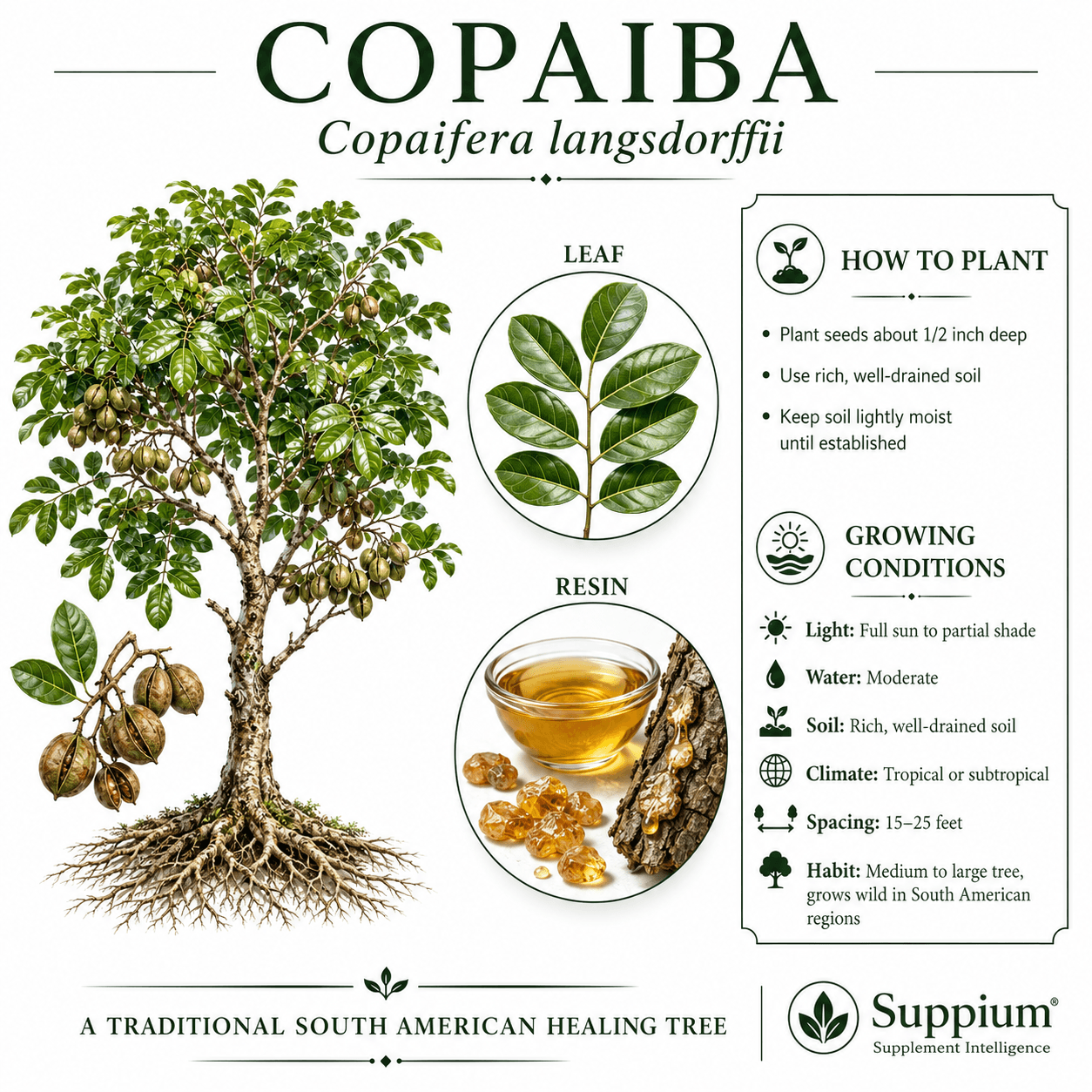
A. Identification
- Common Name (Localized by Country/Region)
- langsdorf's copaifera
- Primary Common Name
- Copaíba
- Scientific (Latin) Name
- Copaifera langsdorffii
- Regional Names, Multilingual Names, and Modisms
- PT: Copaíba DE-DE: copaiva EN-US: langsdorf's copaifera PT-BR: oleiro Also known as: Copaiba oil, Balsam copaiba, 100% copaiba oil, copaiba, copaiba balsam essential oil, copaiba oleoresin extract, copaiba wood oil, copaifera langsdorffii, copaifera officinalis, copaifera officinalis oleoresin extract, Copaiba balsam, brazilian diesel tree, langsdorf's copaifera, copaiba oleoresin
B. Origin and Cultural Context
- General Description
- Copaíba refers to the oleoresin from several Copaifera tree species native to the Amazon. The oil-resin has been used traditionally for inflammation and wound healing.
- Origin and Cultural Context
- Country of Origin: Brazil Geographic Origin: Amazon Basin, Brazil Region: Brazilian Traditional Regions: Amazon Basin, Brazil, Guyana, Argentina (Misiones) Tradition System: Latin American & Amazonian Plant Part Used: Oleoresin from the trunk/bark
Biological Role and Constituents
- Biological Role and Mechanism
- Laboratory and animal studies suggest that diterpene constituents, particularly kaurenoic acid, may exert anti-inflammatory, antimicrobial, hypotensive, diuretic, smooth muscle relaxant, and cytotoxic actions; β-caryophyllene has documented anti-inflammatory activity in laboratory studies. These are mechanisms observed in experimental models and are not established clinical outcomes.
- Active Compounds and Key Constituents
- β-caryophyllenekaurenoic acidcopalic acid
C. Benefits
- Evidence-Based Benefits
- Contains beta-caryophyllene and other sesquiterpenes. Some preclinical and limited human evidence for anti-inflammatory properties.
- Traditional / Historical Uses
- Traditional uses include topical application for wounds, skin conditions, and internal use for inflammation. The oleoresin is distinctive.
- Traditional Claims
- “Copaiba has traditionally been used in Brazil and the Amazon region as a topical analgesic and healing agent, and traditional populations have used it for many purposes. Contemporary municipal fitoterapia guidance in Brazil lists topical uses for healing and as an antiseptic in wounds and ulcers, and for rheumatic and joint pain, as well as psoriasis. These historical and local claims are not established clinical outcomes.”Note: Traditional claims are not necessarily supported by clinical evidence. See Evidence Breakdown below.
- Human Evidence Summary
- A literature review of Copaifera langsdorffii identified studies describing various biological actions, including two clinical studies that evaluated antimicrobial potential of a copaiba-containing dental varnish in children. Data from a pharmacist interaction database lists commonly cited uses such as inflammation and joint pain, skin wounds and irritation, and antimicrobial and antifungal support, but this is not clinical proof of benefit. No large, controlled human trials establishing efficacy were identified.
- Preclinical Summary (In Vitro / Animal)
- In vitro and animal studies have reported anti-inflammatory, antiproliferative, wound-healing, antibacterial, antinociceptive, antiparasitic, antileishmanial, and gastroprotective actions for Copaifera langsdorffii. Rain-Tree's ethnobotanical summary notes that kaurenoic acid has shown anti-inflammatory, hypotensive, and diuretic effects in vivo and antimicrobial, smooth muscle relaxant, and cytotoxic actions in vitro, and that β-caryophyllene has documented anti-inflammatory effects in laboratory studies. These preclinical findings are not predictive of human outcomes.
- Limits of Current Evidence
- The evidence base is dominated by laboratory and animal studies, with very few controlled human trials. Available clinical data are small and preliminary, such as dental varnish studies in children. Preparations vary in composition, and the oleoresin is chemically complex. Long-term safety data are lacking, and information on oral dosing in humans is not robustly established.
D. Contraindications and Safety Warnings
- Contraindications
- May interact with anticoagulants. Internal use may cause digestive upset.
- Warnings
- Quality and species vary significantly. Traditional use primarily topical.
- Known Side Effects
- Reported adverse effects include contact dermatitis and urticaria with topical use. Oral copaiba oil has been reported to irritate tissues and worsen local discomfort in acute urinary tract infections and leukorrhea. A case report described liver damage in an elderly patient using copaiba together with Hypericum perforatum, with recovery after discontinuation of the products.
- Toxicity Risks
- A case report documented hepatotoxicity in an elderly patient after use of Hypericum perforatum and copaiba; the association with copaiba was described as possible rather than established. Preclinical and review sources describe copaiba as having low acute toxicity in experimental settings, but human toxicology data remain limited.
- Pregnancy and Breastfeeding
- Evidence is insufficient. An EU technical regulation table lists Copaifera langsdorffii oleoresin from the bark, and certain related botanical entries carry a label warning not to use during pregnancy or breastfeeding, but no specific pregnancy or lactation warning text for copaiba was confirmed in the retrieved excerpts.
- Children and Older Adults
- A case report of liver damage involved an elderly patient using copaiba with St. John's wort. Specific pediatric and geriatric dosing guidance is not established.
- Regulatory Status
- Copaifera langsdorffii is included in Brazil's National List of Medicinal Plants of Interest to the Unified Health System (RENISUS). In the European Union regulatory system, Copaifera langsdorffii oleoresin from the bark is listed as a botanical ingredient. In the United States, copaiba balsam is available as a dietary supplement ingredient.
E. Interactions (Mandatory)
How this supplement interacts with others. Always consult a healthcare provider before combining supplements.
- Drug Interactions
- No known drug interactions were identified in one pharmacist-managed supplement interaction database for copaiba balsam, but this does not guarantee that no interactions exist.
- Condition-Specific Interactions
- Other Condition-Based Risks: Topical use should be avoided on open lesions. Oral use has been associated with local irritation in acute urinary tract infection and leukorrhea. A case report raised possible association with liver injury, so caution may be warranted in people with liver conditions when combining copaiba with other hepatotoxic herbs.
- May Interfere With
- Hypericum perforatum
F. Dosage Ranges
- Traditional Dosage Range
- Among documented traditional forms, a Brazilian municipal fitoterapia reference describes a 10% copaiba ointment applied topically to affected areas two to three times daily in adults for wound healing and antiseptic use.
- Route-Specific Evidence
- Available information primarily concerns topical use. Brazilian municipal guidance describes topical copaiba ointment. The oleoresin is also available as a liquid or oil in dietary supplement formats, but robust human data on oral use are lacking.
G. Formulations
- Available Forms
- TopicalLiquidOil
- Preparation Methods
- oilcapsuletopical
- Form Variants
- Copaiba oleoresinCopaiba oilCopaiba balsamCopaiba oleoresin extract
- Standardization Notes
- Copaiba oleoresin is a chemically variable natural product, with composition potentially influenced by species, geographic origin, and collection method. Documented constituents include β-caryophyllene, kaurenoic acid, and copalic acid. No widely accepted standardization marker was identified in the sources reviewed.
I. Citations to Public Research
Verified Sources
Research sources behind this entry, strongest evidence first. Traditional-use resources are labelled separately from clinical and regulatory sources.
- 1.Government / regulatoryRetrieved by research
Caderno de Fitoterapia
Prefeitura de Jaraguá do Sul
https://wordpress.jaraguadosul.sc.gov.br/wp-content/plugins/pmjs-paginas//downloads/2464/Caderno-de-Fitoterapia.pdfSupports: Traditional preparation & dosage, Traditional claims, Traditional uses, Contraindications, Side effects
- 2.Government / regulatoryRetrieved by research
EU Technical Regulation Information System notification
European Commission
https://technical-regulation-information-system.ec.europa.eu/pt/notification/16630/text/F/NLSupports: Regulatory notes, Pregnancy & breastfeeding
- 3.Academic / medical institutionRetrieved by research
Copaifera langsdorffii Desf. | Plants of the World Online | Kew Science
Royal Botanic Gardens, Kew
https://powo.science.kew.org/taxon/urn:lsid:ipni.org:names:64920-2/general-informationSupports: Scientific / IUPAC name, Geographic origin detail, Geographic subregion, Traditional-use regions, Aliases & vernacular names
- 4.Academic / medical institutionRetrieved by research
Copaifera langsdorffii
Global Biodiversity Information Facility (GBIF)
https://www.gbif.org/taxon/Y2X9Supports: Regional names by locale, Aliases & vernacular names
- 5.Academic / medical institutionRetrieved by research
Copaíba (Copaifera langsdorffii)
Embrapa
Paulo Ernani R. Carvalhohttps://www.alice.cnptia.embrapa.br/alice/bitstream/doc/1139732/1/Especies-Arboreas-Brasileiras-vol-1-Copaiba.pdfSupports: Scientific / IUPAC name, Regional names by locale, Plant part used
- 6.Academic / medical institutionRetrieved by research
Anais 1 SEFARM: revisão de literatura sobre Copaifera langsdorffii
Universidade Federal do Pará
https://ppgcf.propesp.ufpa.br/ARQUIVOS/documentos/Anais_1_SEFARM.pdfSupports: Active compounds / key constituents, Preclinical evidence summary, Human evidence summary, Traditional uses
- 7.Traditional / ethnobotanicalRetrieved by research
Copaiba by doTERRA: Drug Interactions & Ingredients
HelloPharmacist
https://hellopharmacist.com/drug-supplement-interactions/supplements/copaiba-by-doterra-48579Supports: Drug interactions, Functional tags, Regulatory notes
- 8.Traditional / ethnobotanicalRetrieved by research
COPAIBA OIL
Rain-Tree
http://www.rain-tree.com/brochures/Copaiba.pdfSupports: Traditional uses, Traditional claims
Related Herb & Botanicals
caffeine
1,3,7-trimethylpurine-2,6-dione
1,3,7-Trimethylpurine-2,6-dione is caffeine, a purine alkaloid and methylxanthine compound rather than a true herb. It occurs naturally in several botanicals, including coffee beans, tea leaves, cacao, kola nut, guaraná, yerba mate, guayusa, and yaupon, and it can also be manufactured and added to foods, beverages, medicines, and dietary supplements. Because the administrator-supplied term maps in NIH DSLD to a non-nutrient/non-botanical ingredient group, the canonical category is compound even though many commercial and traditional sources are botanical. Caffeine is widely used for wakefulness, alertness, and performance contexts, and it is also present in some weight-loss and sports-performance supplements. Human evidence is strongest for short-term effects on alertness and for modest improvements in some endurance or intermittent sports tasks when appropriately timed. Evidence for meaningful stand-alone weight loss is weaker because trials often use multicomponent stimulant formulas and short durations. Safety depends heavily on total intake from all sources, individual sensitivity, pregnancy status, medicines, cardiovascular or anxiety conditions, and product concentration. Pure or highly concentrated caffeine powders and liquids are a distinct safety concern because small measuring errors can be toxic or fatal.
Chanca Piedra
Phyllanthus niruri
Chanca Piedra ("stone breaker") is a small herb native to the Amazon rainforest. It has been used in traditional Brazilian and Peruvian medicine for urinary and liver support.
Chinese sage
Salvia miltiorrhiza Bunge
15,16-Dihydrotanshinone I, often shortened to DHT or DHTS and also called dihydrotanshinone I, is a lipophilic abietane diterpenoid belonging to the tanshinone family. Its formal chemical name is (1R)-1,2-dihydro-1,6-dimethyl-phenanthro[1,2-b]furan-10,11-dione, with CAS Registry Number 87205-99-0 and molecular formula C18H14O3. The compound is found naturally in the roots of Salvia miltiorrhiza Bunge, the traditional Chinese herb known as danshen or red sage. Danshen has been used clinically in China for centuries for a range of conditions, though 15,16-dihydrotanshinone I itself is studied primarily as an isolated research compound rather than as a traditional remedy. Most current knowledge about its biological activity comes from in vitro and animal studies. Human evidence specific to this isolated compound is essentially absent. The tanshinone class as a whole has documented in vitro and in vivo bioactivities, but these do not automatically translate to proven effects from taking the isolated compound.
Methoxydienone
13β-ethyl-3-methoxygona-2,5(10)-dien-17-one
13-Ethyl-3-methoxy-gona-2,5(10)-diene-17-one is a synthetic steroidal compound more commonly indexed as methoxygonadiene or methoxydienone. It is not an herb or botanical; NIH’s Dietary Supplement Label Database classifies it as a non-nutrient/non-botanical ingredient group, and FDA has described Max LMG/13-ethyl-3-methoxy-gona-2,5(10)diene-17-one on product labels as a synthetic steroid rather than a dietary ingredient. Chemically, it is a 13β-ethyl gonane steroid with formula C20H28O2 and is related in steroid scaffold to levonorgestrel-family progestins and 19-nor anabolic-androgenic steroids. It has appeared in bodybuilding products under the alias Max LMG, but controlled human trials of oral supplementation for muscle, strength, or health outcomes were not identified. Published human work is mainly forensic/toxicology-oriented and focused on detecting metabolites after very small oral exposure, not on performance or therapeutic use. Preclinical and modeling work suggests possible androgen-receptor relevance, but this should not be interpreted as a proven benefit. Safety concerns are substantial because steroid-like bodybuilding products and anabolic-androgenic steroids are associated with hepatic, cardiovascular, endocrine, reproductive, psychiatric, and thrombotic risks, and product identity/purity may be unreliable.